
Guide
How Many Cold Email Follow-Ups to Send, When, and What to Say
A cold email follow-up is a short message in the same thread that gives a silent prospect a new reason to reply. One email rarely reaches a busy buyer on the right day, but too many follow-ups burn your sending domain and your name. This guide covers how many follow-ups to send, when, what to say and when to stop.
What is a cold email follow-up?
A cold email follow-up is any message you send after the first cold email when the prospect has not replied. The first email and its follow-ups together form a sequence.
A good follow-up is not a reminder of the first email. It adds something the first email did not have, such as a new angle, a useful resource or a simpler question.
The plan behind the sequence matters more than any single message. As a cold email agency, we set the order, spacing and number of follow-ups for each list before the first email goes out.
Why do B2B buyers reply to follow-ups and not the first email?
Many buyers reply to a follow-up because the first email arrived on the wrong day, not because it was the wrong email. A busy inbox buries a message within hours, and a quarter end or a trip does the rest.
A follow-up also gives the reader a second way in. If the first angle missed, a different problem, a resource or a smaller question may fit their week better.
So each follow-up needs its own reason to exist. We plan the whole sequence before launch, instead of writing follow-ups as an afterthought.
How many follow-ups should you send?
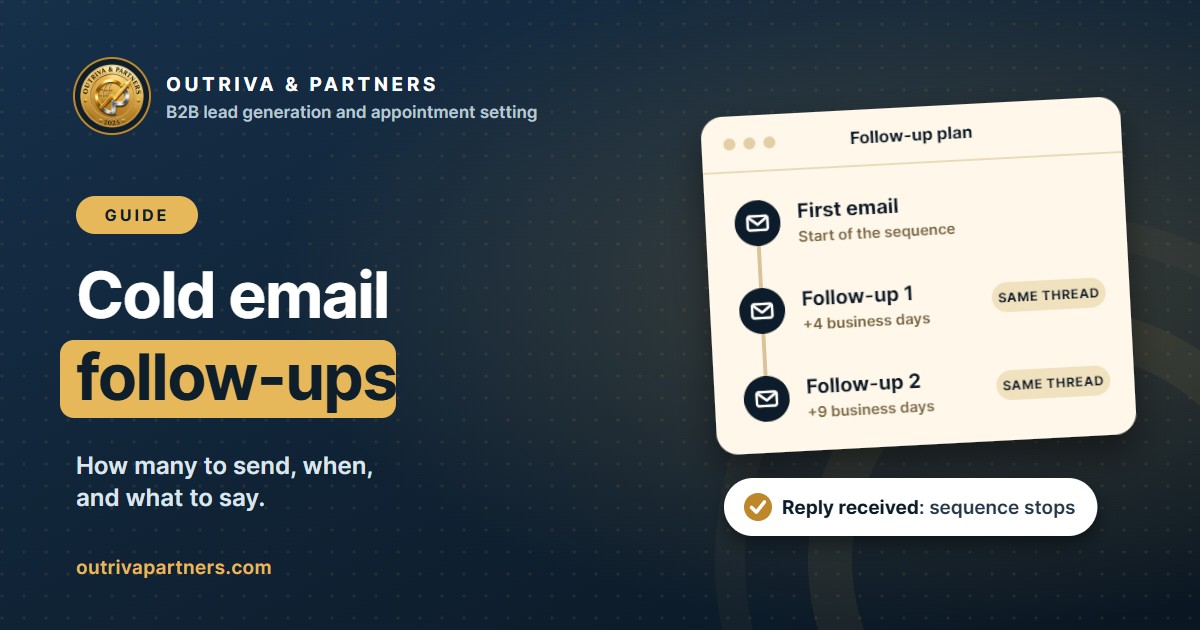
For most B2B lists, two follow-ups are enough. We send two follow-ups over two weeks, so each contact gets three emails in total.
A few things change that plan:
- Seniority. Senior executives get one or two personalized follow-ups over two to three weeks. A weak follow-up costs more goodwill at that level.
- Account value. For a major account, we reach two or three relevant people over four to six weeks. Each person still gets the usual number of emails, not more.
- Signals from the list. Rising unsubscribes or complaints mean the list or the message is wrong, and more steps will not fix that.
Extra steps stop paying once they add volume without adding a reason. We agree meeting targets in writing under the Assured Outreach Model. So we judge a sequence by held meetings, not by how many emails went out.
How long should you wait between follow-ups?
Wait four business days before the first follow-up and five more before the second. Short gaps keep the thread fresh, and the slightly longer second gap keeps the sequence from feeling like pressure.
| Step | When it goes out | Gap since the last email |
|---|---|---|
| First email | Start of the sequence | None |
| Follow-up 1 | 4 business days after the first email | 4 business days |
| Follow-up 2 | 9 business days after the first email | 5 business days |
Take a prospect in London and a first email on a Monday. Follow-up 1 goes out that Friday, and follow-up 2 on the Friday of the next week.
Count business days in the prospect’s country, not yours, and skip their public holidays. We also send every email during the prospect’s local business hours.
The UAE federal government works Monday to Thursday plus a half day on Friday, with Saturday and Sunday off, according to the UAE government portal. Sharjah’s government takes Friday to Sunday off.
Saudi Arabia’s working week runs Sunday to Thursday, with a Friday and Saturday weekend, as the Saudi Central Bank notes. So for a prospect in Riyadh, a first email on a Monday means follow-up 1 goes out on Sunday, not Friday. Across APAC, local business hours often fall at night in Europe.
What should each follow-up say?
Each follow-up should do one new job and ask one easy question. We give each follow-up one of the five jobs below and keep it in the same thread as the first email.
| Job | Use it when | Example opening line |
|---|---|---|
| A new angle | The first reason to talk may not have landed | “One more thought on {problem}, from the side of {their team}.” |
| A useful resource | You have something short that helps this reader | “This one-page note shows how {peer type} handle {problem}.” |
| The right person | The topic may sit with someone else | “If {topic} sits with someone else on your team, who should I ask?” |
| A smaller ask | The prospect may be interested but busy | “Would a short written answer help more than a call?” |
| Close the loop | It is the last email you plan to send | “I will stop here. A reply to this email reaches me if {problem} comes back.” |
A few rules apply to every step. Keep the follow-up shorter than the first email, ask one question and write in plain text.
Never send “just checking in”. It asks the reader to do work for you and gives them nothing new to answer.
Cold email follow-up templates for B2B
These five templates match the five jobs above, and each one works for a stated reason. Replace every part in braces with something true about the prospect, or do not send it.
1. The new angle
| Hi {first name}, One more thought on {problem}. Teams like {their company} often see it first in {symptom}, before it shows up in {metric}. Is that on your list this quarter? {your name} |
Why it works: it gives a second reason to care without repeating the first email. The question is easy to answer with yes or no.
2. The useful resource
| Hi {first name}, No ask this time. This short note shows how {peer type} set up {process}, in case it helps your team. {one-line summary of the note} {your name} |
Why it works: it gives value first and lowers the pressure. Send it only when the resource is short, specific and actually useful to that reader.
3. The right person
| Hi {first name}, I may have reached the wrong person. If {topic} sits with someone else at {their company}, who would you suggest I speak to? {your name} |
Why it works: it is quick to answer and respects the reader’s time. A referral from inside the account also gives your next email a reason to be read.
4. The smaller ask
| Hi {first name}, A call may be too much right now. Would it help if I sent three short points on how {peer type} handle {problem}? {your name} |
Why it works: a smaller next step is easier to accept. It keeps the conversation alive when the reader is interested but busy.
5. Close the loop
| Hi {first name}, I will stop here, as this does not seem to be a priority now. If {problem} comes back on your list, a reply to this email reaches me directly. {your name} |
Why it works: it ends the sequence politely and often draws a “not now, try in spring” reply. That answer tells you when to come back.
When should you stop following up?
Stop the moment a prospect replies, opts out or bounces, and after the last planned step. What happens next depends on the reply.
| Reply or event | What happens next |
|---|---|
| Interested reply | The sequence stops, and a person answers and qualifies the reply |
| “Not now” | The sequence stops. We follow up when they suggest, or after 30 to 60 days if they gave no timeframe |
| “Talk to my colleague” | The sequence stops; the colleague gets a new first email that names the referral |
| Out of office | The sequence pauses and resumes 1 to 2 business days after their stated return date |
| No reply after follow-up 2 | The cold sequence ends. We look at the contact again after 60 to 90 days |
| Unsubscribe or objection | Stop for good, and add the contact to the suppression list for every channel |
| Hard bounce | Remove the address and check where the data came from |
In practice at OUTRIVA. A person reads and answers every reply, including the blunt ones. When we look at a silent contact again after 60 to 90 days, we write only if we have a new, relevant reason.
How do follow-ups affect deliverability and compliance?
Every follow-up is a new commercial email, so it adds to your sending volume and complaint risk, and it needs its own opt-out. A long sequence to a weak list costs more than it earns.
Gmail’s sender guidelines FAQ asks senders to keep the user-reported spam rate below 0.1% and never reach 0.3%. It also recommends honoring unsubscribe requests within 48 hours.
Each extra step is another chance for an annoyed reader to press “Report spam”. Our guide on what Gmail and Outlook changed for senders covers authentication and the bulk sender rules.
The legal rules apply to every follow-up, just as they apply to the first email. This is a summary, not legal advice.
- United States. The FTC’s CAN-SPAM compliance guide makes no exception for business email. Each message needs a clear way to opt out, and you must honor a request within 10 business days.
- United Kingdom and EU. Under Article 21 of the UK GDPR, a person can object to direct marketing at any time. After that, you may no longer use their data for marketing, and the EU GDPR has the same article.
Treat one opt-out as an opt-out from every channel, so nobody who unsubscribed by email hears from you on LinkedIn. Our page on lead generation for UK companies covers the UK email rules for companies and sole traders.
Should follow-ups switch from email to LinkedIn or WhatsApp?
Yes, when your buyers use those channels. Every prospect should meet one coordinated sequence, not one email sent twice.
We combine email with LinkedIn connection requests and comment activity, and add WhatsApp where it is normal business practice. The email follow-ups stay in one thread, where the reader can still see the first message. Our LinkedIn lead generation work runs the profile, the connection requests and the messages.
WhatsApp fits markets such as the Middle East and parts of APAC, and we build it on permission. Our page on B2B WhatsApp outreach explains how. We do not add cold calls to follow-up sequences.
Our team plans the sequence, runs it across email and LinkedIn, and answers every reply. Book A Strategy Call to see how we would plan follow-ups for your list.
What should you send after a sales call or first meeting?
Send a short recap the same business day, from the person who led the meeting. List what you heard, the agreed next steps, who owns each one and when it is due.
Before a meeting, the prospect gets a calendar invite by email as soon as we book it. Email reminders follow 24 hours and 1 hour before the meeting, each with the join link. If we book the meeting less than 24 hours ahead, we skip the first reminder.
Our guide on how qualified meetings and no-shows are counted explains why a held meeting is the number that matters.
After the meeting, the recap should come from the person on your team who led it. We can draft it for them, with the agreed next steps, who owns each one and when it is due. A simple version looks like this.
| Hi {first name}, Thank you for your time today. What I heard: {their problem, in their words}. What we agreed: {next step 1}: {owner}, by {date} {next step 2}: {owner}, by {date} If I missed anything, reply here and I will update it. {your name} |
Frequently asked questions
How many times should you follow up on a cold email?
For most B2B lists we send two follow-ups after the first email, over about two weeks. Stop earlier if the prospect replies, opts out or bounces, or if complaints start to rise.
Should a cold email follow-up go in the same thread?
Yes. We keep every follow-up in the same thread, so the first email stays visible and the reader has the context without searching.
Is “just checking in” a bad follow-up?
Yes. It gives the reader nothing new to respond to. Add a new angle, a useful resource or a smaller question instead.
What if a prospect opens my email but does not reply?
Treat it as no reply. Apple Mail Privacy Protection loads images automatically, so a tracked open can happen when nobody read the email.
When can you contact a “not now” prospect again?
Come back when they told you to, or after 30 to 60 days if they gave no date. Mention their earlier answer so the message reads as a follow-up, not a new cold email.
Follow-ups turn one email into a conversation when each step adds a reason to reply and the plan knows when to stop. We plan, send and answer them for you, with the meeting targets agreed in writing first. Book A Strategy Call to go through your list, your offer and a sensible follow-up plan.
How we wrote this guide. The sender, legal and working-week rules come from Google, the FTC, the UK GDPR, the UAE government and the Saudi Central Bank, all linked above. The number of follow-ups, the timing, the stop rules and the meeting reminders come from how OUTRIVA runs its campaigns.