
Guide
What Is Appointment Setting? A Guide for B2B Buyers
Appointment setting is the outbound work of finding the right buyers and booking qualified sales meetings with them. Many companies pay for meetings that go nowhere because nobody defined “qualified” first, which wastes closer time and pipeline budget. This guide explains how it works, what counts as a qualified meeting and how to judge a provider.
What is appointment setting?
Appointment setting is the process of turning target accounts into scheduled meetings with your sales team. It is the booking end of B2B lead generation, where a qualified conversation becomes a booked time. Our B2B appointment setting agency service runs both together.
The work stops once the prospect attends the meeting. What happens in the meeting is sales, and your closer owns it. You may also hear the work called meeting booking or sales appointment setting.
This guide speaks to the founder, VP of Sales or CMO who is deciding how to build pipeline. It does not cover the job of an appointment setter.
How is appointment setting different from lead generation, SDR work and cold calling?
Appointment setting is the final step of lead generation, and it ends in a held meeting. Lead generation covers the whole path from a cold list to a qualified conversation. SDR work and cold calling overlap with both, so the output is the cleanest way to tell them apart.
| Term | What it produces | What you are usually billed for |
|---|---|---|
| Lead generation | The whole path from a cold list to a qualified conversation | Contacts, leads or a written result |
| Appointment setting | Held meetings with fitting buyers | Meetings or a written result |
| SDR work | Meetings, plus ongoing prospecting inside your team | Salary, or a retainer if outsourced |
| Cold calling | Conversations on one channel | Hours or calls made |
Look at the billing unit. A vendor that charges per contact sells lead generation, and a vendor that charges against meetings sells appointment setting. For the wider picture, see our B2B lead generation services.
Who is appointment setting for, and who should skip it?
Appointment setting suits companies with a defined buyer, a closer who can run the meetings, and a deal large enough to justify outbound work. We work mostly with SaaS, IT services, technology, biotech, pharma and professional services firms.
It is a poor fit in four cases:
- You have no closer with open slots each week.
- You cannot describe your ideal customer profile (ICP) in writing.
- You cannot reply to a qualified lead within two business days.
- You sell low-priced products to consumers.
If you are still choosing between outbound and inbound, our guide on inbound vs outbound sales gives a simple test.
How does appointment setting work, step by step?
A working campaign runs through nine steps, from agreeing who you sell to, to logging the meeting in your CRM.
- Agree the ICP, the offer and the objection list.
- Build and verify the target list.
- Write the messages and the sequence.
- Set up and warm the sending domains.
- Launch outreach at a controlled volume.
- Handle replies.
- Qualify the prospect against the agreed gates.
- Book the meeting, then confirm and remind.
- Log every contact and meeting in your CRM, and report weekly.
In practice at OUTRIVA
In week one we run a working session on your ICP, your offer and your objection list. We agree the KPIs and the qualification bar in writing.
In weeks one and two we build the target list, verify it and write the sequences. Sending domains go up and start warming, and nothing goes out until you approve the messaging.
Outreach starts in week three at a controlled volume. Early on we watch reply quality more closely than reply rate. First meetings usually land between week three and week five, and from week seven we scale what works.
Week markers are typical, not contractual. New markets and untested offers take longer, and we tell you so at the start. A named strategist runs your campaign and answers for the numbers.
What counts as a qualified appointment?
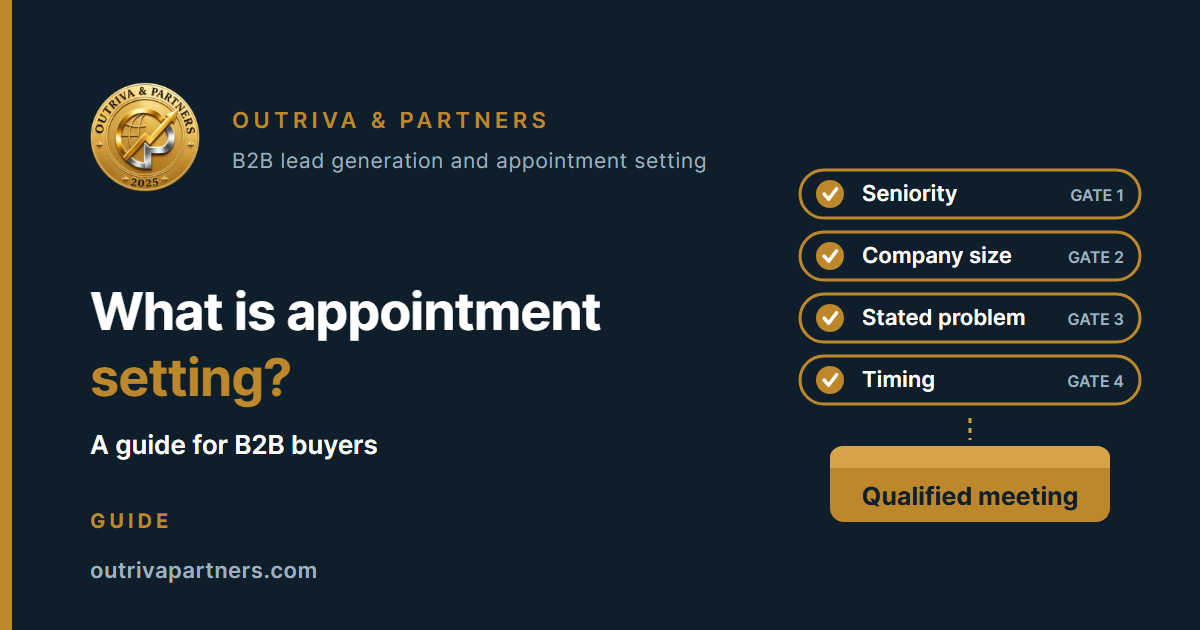
A qualified appointment is a held meeting with a buyer who clears every gate you agreed in advance. Three terms are easy to confuse, so keep them separate.
- Interested replyThe starting point
- 1SeniorityBudget authority, or one step from it.
- 2Company sizeInside the agreed headcount and revenue range.
- 3Stated problemNamed in their own words.
- 4TimingA reason to talk now.
- ✓QualifiedCounts toward the KPI.
| Term | Meaning |
|---|---|
| Booked | The prospect agreed to a date and time. |
| Held | The prospect attended and the conversation happened. |
| Qualified | The prospect clears all four gates. |
Each gate is a written definition. We agree exact job titles with you during onboarding, so you know the bar before any message goes out.
| Gate | What it checks | What a pass looks like |
|---|---|---|
| Seniority | Whether the contact can buy | Holds budget authority, or sits one step from it |
| Company size | Whether the account fits your range | Inside the agreed headcount and revenue range |
| Stated problem | Whether there is a need | The contact names a problem your product solves, in their own words |
| Timing | Whether there is a reason to talk now | A live project, a renewal date or a compliance deadline |
A meeting that fails one gate does not count, and we replace it at no extra service charge. If the prospect does not match your ICP, the meeting does not count. If the prospect does match, we review the meeting details with you before we decide.
These meetings never count: a no-show that is not rebooked, a prospect outside the ICP, and a contact with no route to a buyer.
If you want the gates written and run for you, our appointment setting service does the work under the Assured Outreach Model. Book A Strategy Call and we will scope it with you.
Which channels do appointment setters use?
Appointment setters reach buyers through email, LinkedIn, phone and, in some regions, WhatsApp. Each channel fits a different buyer.
| Channel | Where it fits | What to watch |
|---|---|---|
| The volume channel, and the one that carries most testing | Sending setup and list quality | |
| Senior titles in SaaS and tech, where inboxes are crowded but profiles stay active | Message volume per profile | |
| Phone | Fast conversations with buyers who answer | Calling rules for the country |
| Normal business practice in the Middle East and parts of APAC | Regional norms |
We mostly run LinkedIn and email. The mix for each campaign depends on your requirements and on the results we see. We tell you which mix we run before we start.
See our LinkedIn lead generation services and our cold email outreach.
What happens when a prospect does not show?
A no-show is a booked meeting that never became a conversation, so it does not count as qualified.
We confirm and remind before every call. If the prospect misses it, we chase a reschedule. After two failed attempts, we replace the meeting at no extra service charge.
How do you measure appointment setting?
Measure three numbers separately: meetings booked, meetings held and meetings qualified. One total hides where the problem is.
| Measure | How to calculate it | What it shows |
|---|---|---|
| Show rate | Meetings held divided by meetings booked | Whether people attend |
| Qualified rate | Qualified meetings divided by meetings held | Whether the targeting and the bar are right |
| Cost per qualified meeting | Total fee divided by qualified meetings | What a usable meeting costs you |
You should see a weekly view of sends, replies, conversations and meetings. If the show rate is healthy and the qualified rate is low, the targeting needs work.
How is appointment setting priced?
Providers usually sell appointment setting in one of three ways. These are a monthly retainer, a fee per booked appointment, and terms that write the result into the contract.
With a retainer, you pay for activity whether or not meetings arrive. With a fee per booked appointment, the provider gains from lowering the bar. With a written result, the provider carries the delivery risk.
We use the third, the Assured Outreach Model. We agree the KPIs in writing before the campaign starts. If we miss them inside the agreed project period, outreach continues at no extra service charge until the number is met.
We do not publish prices, because scope drives the cost. See how a quote is built.
Should you build in-house, outsource or mix the two?
Build in-house when you can hire, train and manage a team and you have steady volume. Outsource when you want to test a market or start faster.
| Model | Strength | Trade-off | Best fit |
|---|---|---|---|
| In-house | Deep product knowledge | Hiring, training and management time | Complex product, steady volume |
| Outsourced | A faster start and no hiring | You depend on the provider’s quality | Testing a market or an offer |
| Hybrid | Proves the motion before you hire | Needs a planned handover | Teams moving from test to scale |
Our outsourced SDR vs in-house comparison covers the cost side of this choice.
What rules apply to outbound B2B contact?
Regulators govern outbound B2B contact, and the rules depend on the country and the channel. This section is a summary, not legal advice.
In the UK, the ICO’s guidance on business-to-business marketing separates corporate subscribers from sole traders and some partnerships. For email to corporate subscribers you must not disguise your identity, and you must give a valid opt-out address. For live B2B calls, you must screen against both the CTPS and the TPS.
In the US, the FTC’s CAN-SPAM compliance guide says the law makes no exception for business-to-business email. It requires accurate headers, honest subject lines, a physical postal address and a working opt-out that you honor within 10 business days.
Mailbox providers add their own rules. Gmail, for example, sets email sender requirements for authentication and spam rates. Our cold email page covers how we handle GDPR, PECR, CAN-SPAM and CASL.
Frequently asked questions
Is appointment setting legit?
Yes. It is a standard outbound function that companies run in-house or outsource. Quality varies, so judge a provider by how it defines a qualified meeting and what it does when one fails.
What does an appointment setter do?
An appointment setter finds the right buyers, contacts them, handles replies and books meetings for your sales team. At an agency, a named owner runs the campaign.
How long until the first meetings?
Most campaigns produce first meetings between week three and week five. Build and domain warming fill the first two weeks, and new markets run longer.
What is the difference between a booked and a held meeting?
A booked meeting has a date. A held meeting took place with the prospect present. Only held meetings can qualify.
Does appointment setting replace my sales team?
No. Appointment setting ends once the meeting takes place. Your closer runs the conversation and the deal.
If you want qualified meetings built on written gates and agreed KPIs, our B2B appointment setting service runs the work for you. Book A Strategy Call to scope it.
How we wrote this guide. The rules in the last section come from the ICO, the FTC and Google, linked above. The process steps, gates and no-show handling come from OUTRIVA’s own campaigns.