
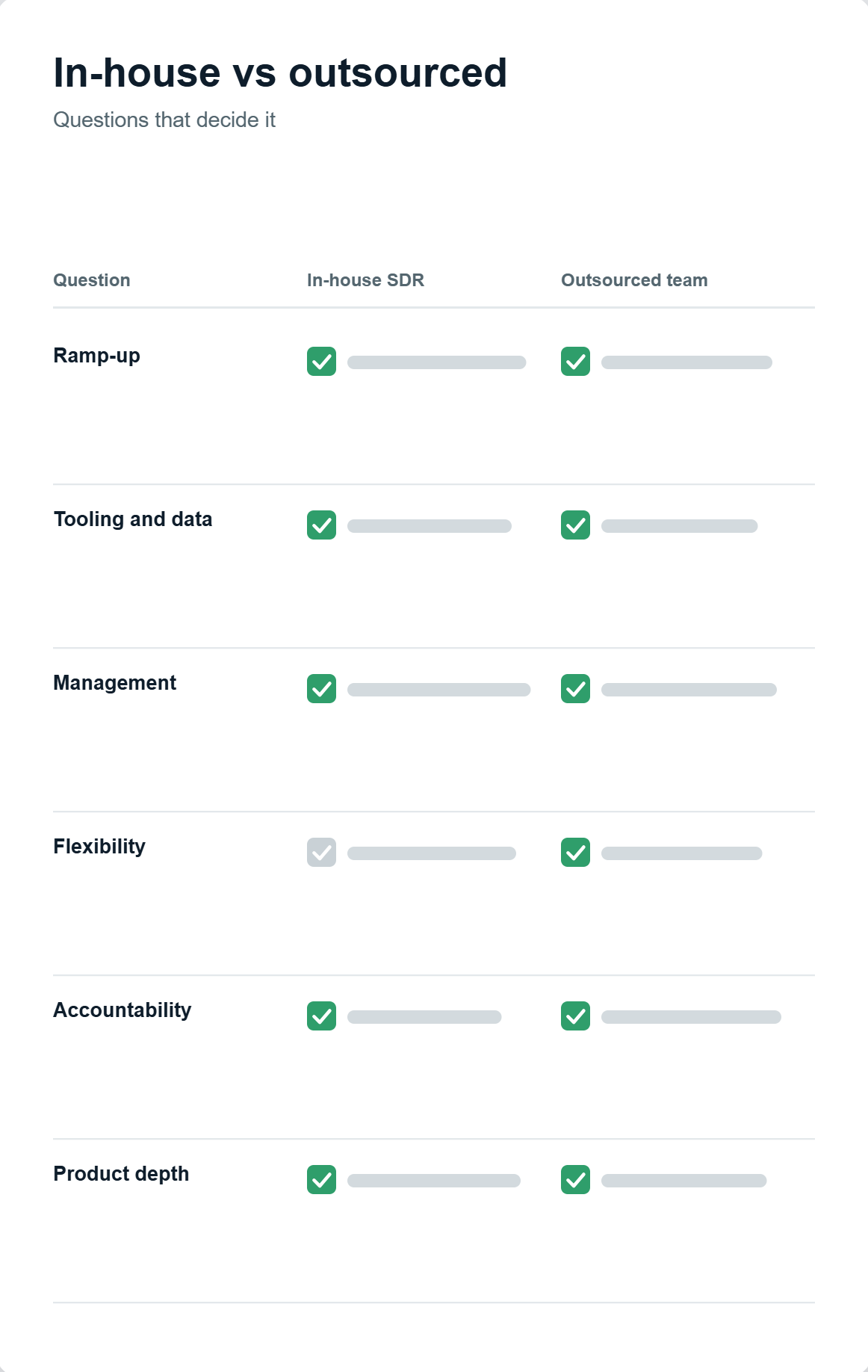
Six questions that decide it
Outsourced SDR or in-house: what to weigh
An outsourced SDR team and an in-house hire do the same job in different ways. These six questions show which one fits your pipeline.
When outsourcing is the wrong call
It is the wrong call in two cases. Your product needs deep technical selling from the first message, or you already have a sales leader with spare time and a long runway. We say so on the first call.
It also does not replace your closers. Someone on your side must hold the meetings we book.
The full scope
What an outsourced SDR team covers
Outsourced SDR work covers the whole path from a cold name to a held meeting. Our SDR as a service team runs it for you.
ICP and list building
We define your ideal customer profile (ICP), then source and verify the contacts.
Messaging and sequences
We write the angles, offers and objection handling. Nothing goes out until you approve it.
Multichannel outreach
We run the channel mix that fits each account, across email, LinkedIn, WhatsApp and calls.
Reply handling and qualification
A person answers every reply and screens it against the qualification bar set at the start.
Booking and reminders
We place meetings on your closer's calendar and confirm each one before the call.
Reporting and CRM logging
A weekly view of sends, replies, conversations and meetings, with every contact logged in your CRM.
A way to decide
How to choose in five steps
Use this order. It takes the guesswork out of a choice that often gets made on instinct.
The decision turns on two things: whether a sales leader has weekly time for SDRs, and how long you can wait for meetings.
Name the gap
Write down whether the gap is meetings, management time or speed. Each answer points to a different model.
Check your leader
Count the weekly hours a sales leader can give to coaching SDRs. If the answer is close to zero, an in-house hire will stall.
Set a runway
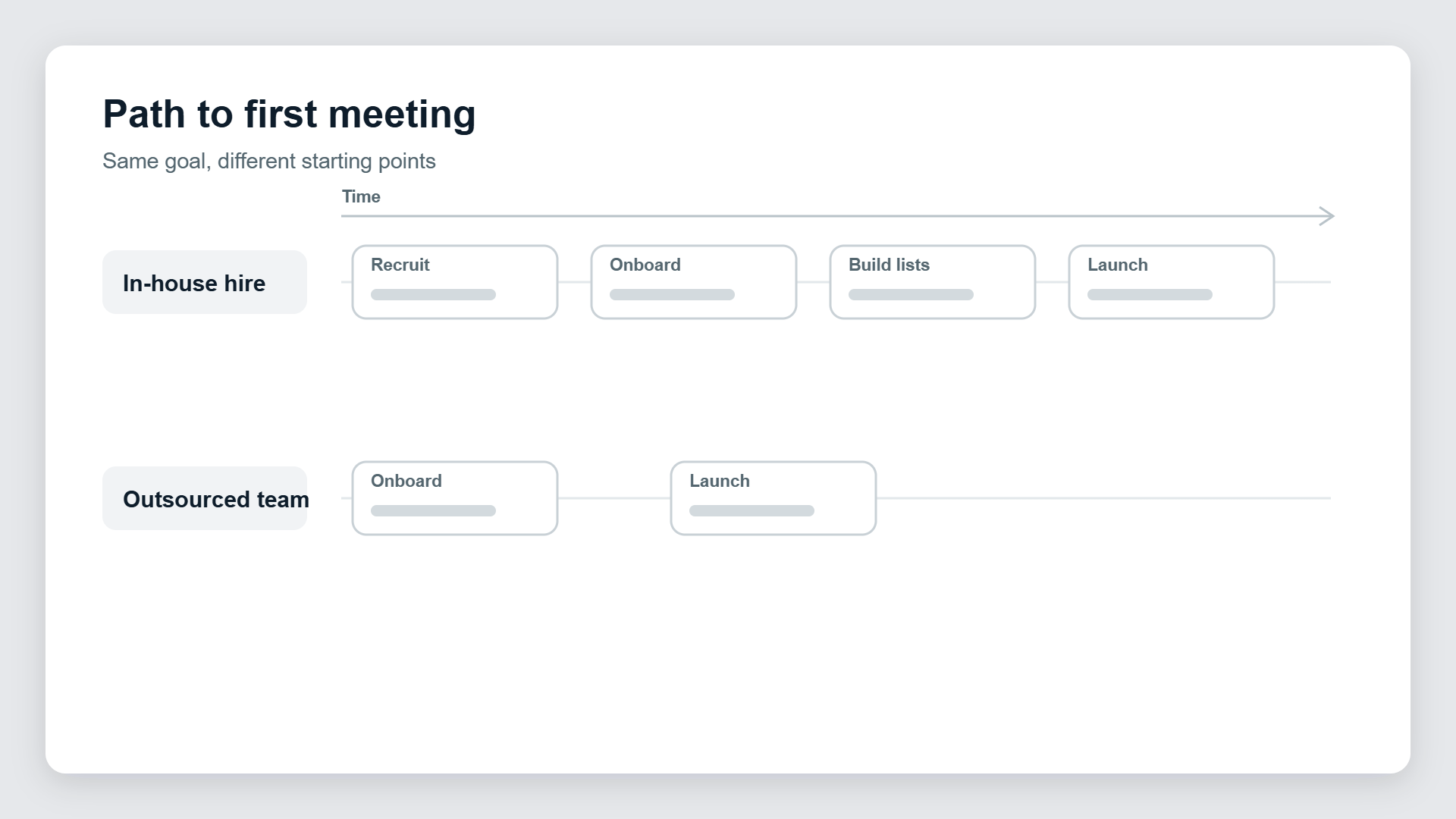
Decide how long you can wait for first meetings. A short runway favors a team that arrives with its process.
Test one market
Run one segment as a project with agreed numbers. You learn what works before you commit to a hire.
Decide with evidence
After the project period, compare the result with your hiring plan. Some teams keep outsourcing, some hire, and some run both.
Three setups
Ways to staff outbound
Most B2B teams end up with one of three setups. Each one trades control against speed.
In-house SDR
You hire, train and manage. You control the pitch and the product depth, and you carry ramp time, data and tooling.
Outsourced SDR team
A team runs the program under agreed numbers. You keep your closers and approve the messaging.
Start outsourced, hire later
Run a project first. Use it to learn which segments and angles answer, then hire against that evidence.
What stays with you either way
Your closers hold the meetings, and you answer qualified leads within two business days. Your sales lead signs off the numbers and the messaging.
Product knowledge also stays with you. We learn it through onboarding, and we flag the questions we cannot answer.
The Assured Outreach Model
What to expect from us
The number is agreed in writing whichever setup you pick. Read the full terms on the Assured Outreach Model page.
If we miss the numbers we agreed, we keep working until we don't.
- iBefore the campaign starts, we agree the KPIs together. Meeting volume, the qualification bar and the target account list all go in writing.
- iiYour sales lead signs off on those numbers, and so do we. Not a pitch deck, not a verbal target.
- iiiIf we miss them inside the agreed project period, outreach continues at no extra service charge until the number is met.
Scope: applies to our service fee. Third-party tool subscriptions and any ad spend stay as they are.
Book a Strategy Call →A shared workload
What we need from you
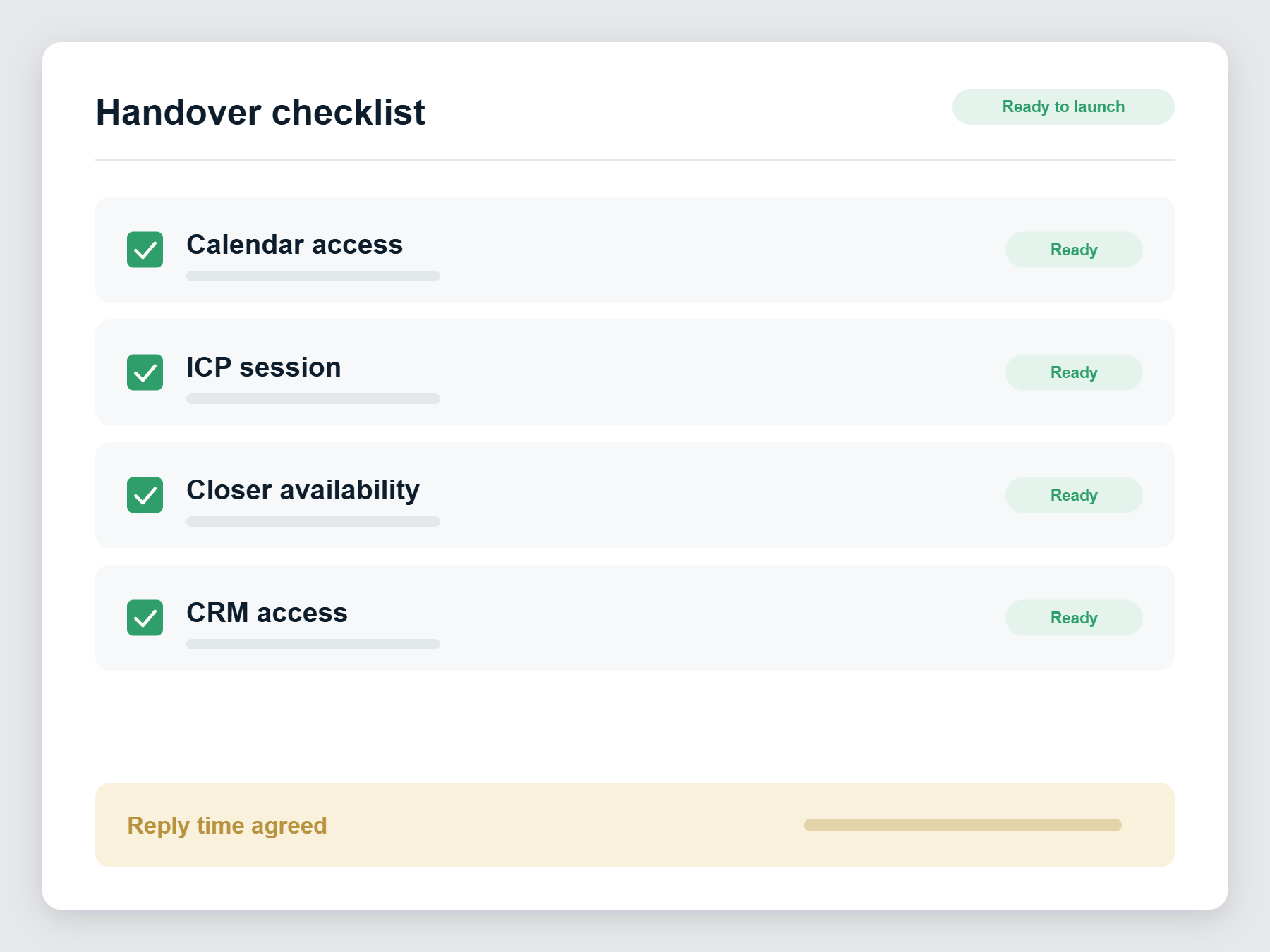
An outsourced SDR team still depends on a few things from your side.
Calendar access
Direct booking rights for each closer.
ICP input
One session at the start, plus feedback on the first twenty leads.
Closer availability
Enough open slots each week to hold the meetings we book.
Reply time
A response within two business days on any qualified lead.
An SDR team can book the meeting. Only your closers can win it.
If your closers need scripts or a follow-up cadence to work these meetings, that sits with our sales enablement work.
Common questions
Frequently asked questions
Is an outsourced SDR cheaper than an in-house hire?
It depends on volume, markets and how long you run. We do not publish prices, because scope drives the cost. A fair comparison counts salary, tools, data, management time and ramp on the in-house side. See our pricing page for how we structure quotes.
How fast can an outsourced SDR team start?
Most campaigns produce first meetings between week three and week five. Build and domain warming fill the first two weeks. New markets and untested offers take longer.
Will an outsourced team know our product well enough?
We learn it through an onboarding session and your feedback on the first leads. Deeply technical products take longer, and we tell you that at the start.
Can we hire an SDR later?
Yes. A project shows which segments and angles answer, which makes a later hire easier to brief.
What does an outsourced SDR team not do?
We do not close deals or replace your sales team. We also do not promise revenue, only the meetings and the qualification bar we agree in writing.
The next step
Ready to compare the options?
Book a strategy call. We will walk through your pipeline, your sales leader's time and your closer capacity, then tell you which setup we would pick.
If the fit is wrong, we will tell you.
Thirty minutes · No pitch deck · Case studies shared on request