

Fit
Who SDR services for SaaS companies suit
This suits B2B companies that already close deals but do not start enough conversations. You have a proven offer, a defined buyer and deal sizes that justify dedicated outbound effort. Most are past their first customers and now building a repeatable sales motion.
We run SDR services for SaaS companies, IT services firms, biotech and pharma suppliers, and technology vendors selling into Europe, APAC and the Middle East. Common triggers are a new market entry, a founder who can no longer prospect and sell at once, or a first sales hire who needs pipeline from week one.
Long buying cycles and several people in the decision are normal here, and sequences are built to reach each of them.
The symptoms
Why outbound stops working
Outbound usually fails for reasons you can already see in your own numbers. Reply rates drop month after month. Messages land in spam or promotions, so nobody reads them. The contact list has aged, and a good share of those people have moved on.
Founders end up prospecting between customer calls, so outreach happens in bursts and then stops for three weeks. A junior hire sends volume without research, and every message reads as generic. Meetings get booked with people who cannot sign anything, and your closers lose hours on calls that go nowhere.
The quarter ends, pipeline is thin, and everyone agrees to fix it next month. Nothing changes, because nobody owns the work from list to booked meeting.
Scope of work
What SDR as a service includes
Five parts make up the work, and we deliver all of them. We build the target list, write the messages, run the sending infrastructure, make the calls and hand over qualified meetings. You approve the buyer profile and the messaging direction at the start. Daily execution then sits with us.
Ideal customer profile and target account research
We start by defining who actually buys. That covers job titles, company size, funding stage, technology signals and buying triggers. We then build the account and contact list by hand and check every record against the profile. Bought lists are never used, and each contact is verified for role and email validity before sending starts.
Your dedicated SDR team
You get a dedicated SDR team assigned to your account rather than a shared pool. The same people learn your product, your objections and your buyers, and they keep learning across the engagement. They join a weekly call with you, work inside your Slack or Teams channel if you prefer, and write in your voice. Holiday cover is arranged so sending never pauses.
Multichannel sequences across email, LinkedIn and phone
Every prospect meets a coordinated sequence, not one email sent twice. We combine written outreach, LinkedIn connection and comment activity, and phone calls at the points where a call helps most. Message variants run in small batches, and the weaker version is retired once the data is clear. Sequences differ by segment, so a biotech buyer never reads a SaaS pitch.
Email infrastructure and deliverability
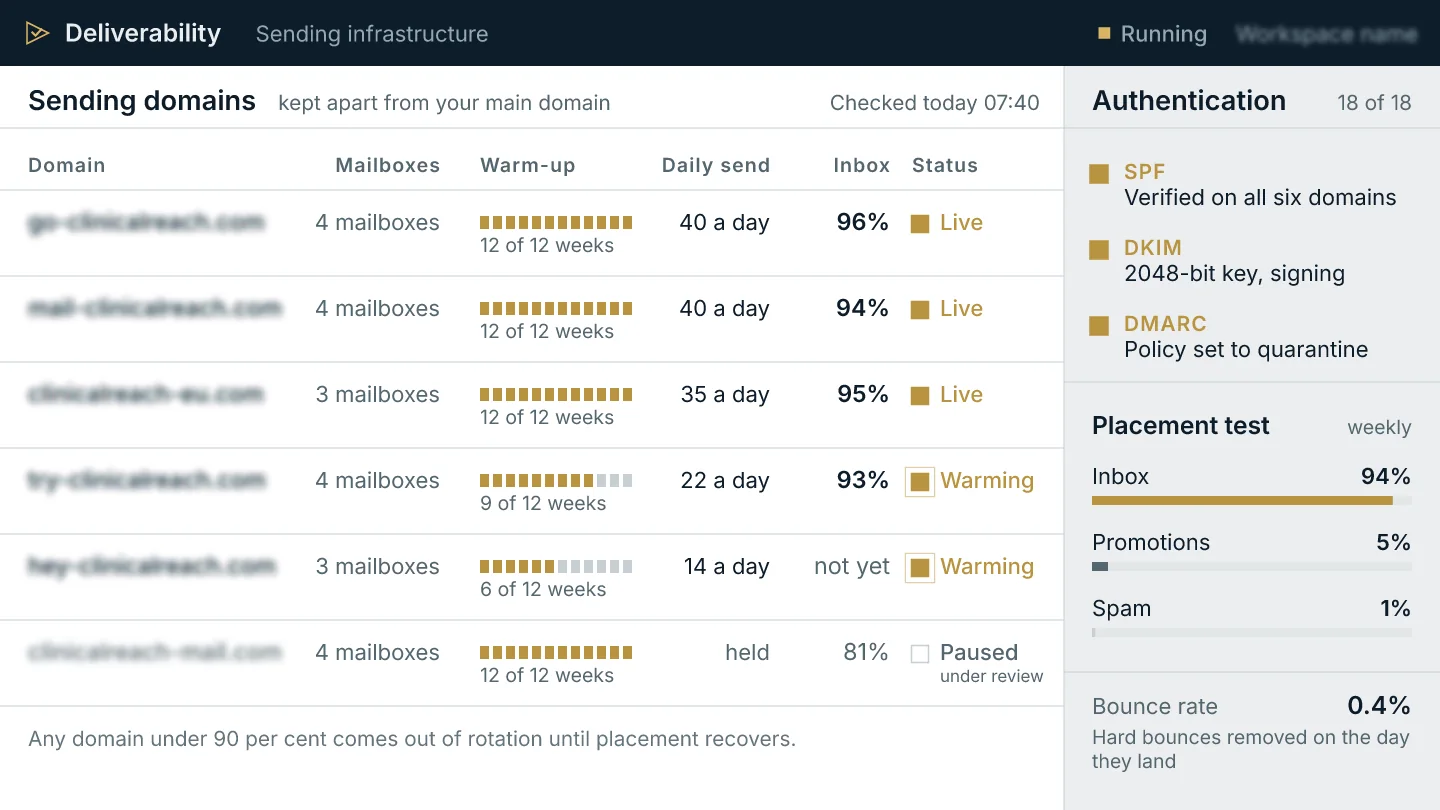
Deliverability is set up before any outreach begins. We configure sending domains that sit apart from your main domain, then authenticate them with SPF, DKIM and DMARC, the records that prove to mailbox providers your mail is genuine. Each mailbox is warmed slowly and kept at low daily volume. We watch placement and bounce rates weekly, and pause any domain that slips.
Qualification, booking and handover
Meetings are booked only when the prospect meets criteria you set. We agree those rules in writing first, covering role, need, timing and buying authority. Every accepted meeting arrives with a short brief, the source of the contact and the full message history. Bookings drop straight into your calendar and into your CRM, the customer relationship management system your team already uses.
The engagement
How we run B2B outbound prospecting services
The work runs in three phases, and first meetings usually land in week five or six.
Phase one
Weeks one and two
We run a kickoff, agree the buyer profile and the qualification rules, and review anything you have sent before. Sending domains are bought and warmed. You contribute product access, two or three recorded sales calls and an hour of your time.
Phase two
Weeks three and four
The list is built and the first messages are drafted. You approve the opening sequences. Sending starts at low volume into a small segment, so we can read real responses before scaling.
Phase three
Week five onwards
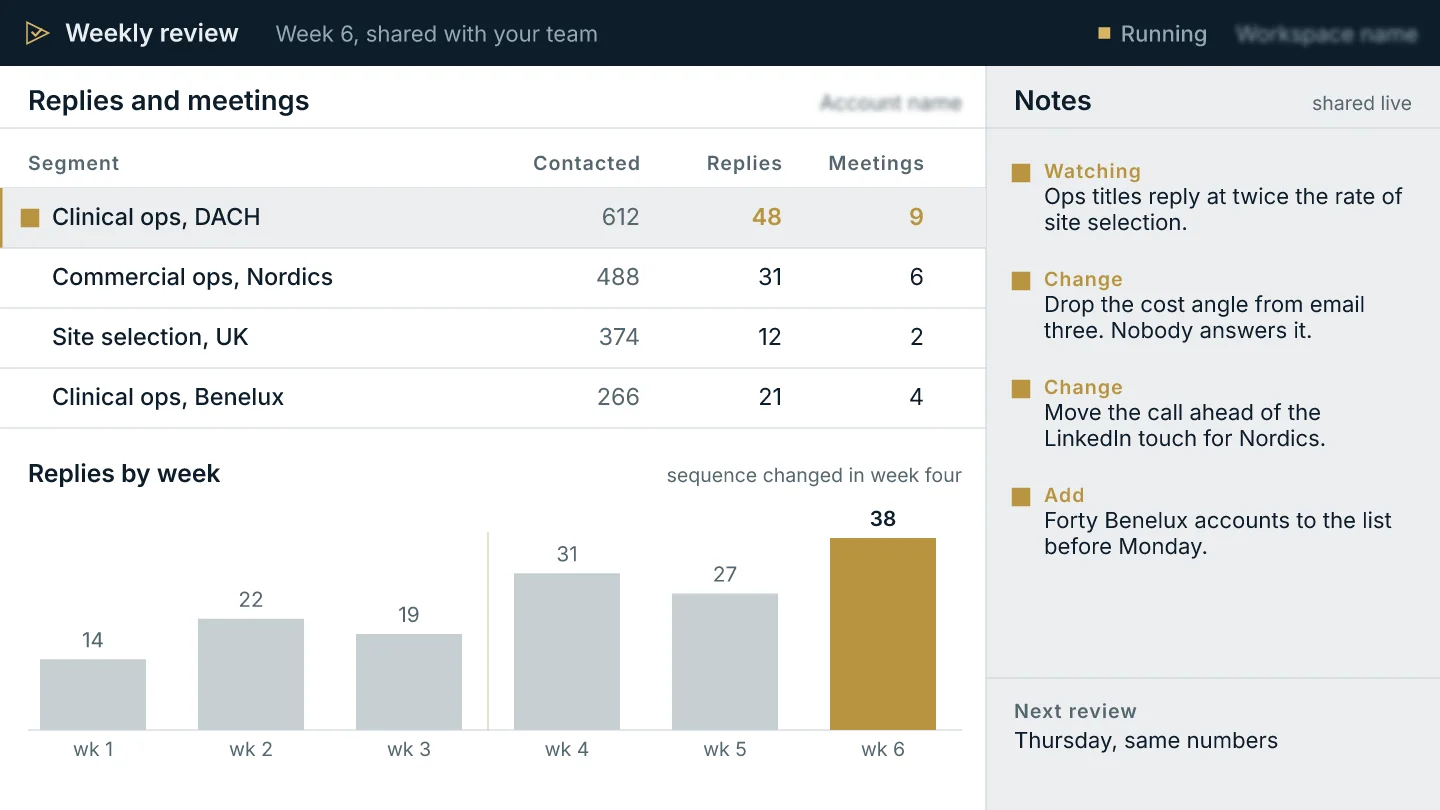
Volume rises, calling begins and meetings start to book. We review the numbers with you weekly and change the segment, offer angle or channel mix based on what actually replies.
Our B2B outbound prospecting services keep running on that loop for the length of the engagement. Nothing is set once and forgotten, and you see the same numbers we do.
Handover
What you receive
You receive working assets, not a strategy deck. Everything below stays with you if the engagement ends.
Each engagement includes the following.
- A written ideal customer profile document with segments and buying triggers
- A verified target account and contact list, exported into your CRM
- Full sequence copy for email, LinkedIn and phone, including the variants tested
- Configured sending domains and mailboxes, transferred into your ownership
- Weekly reporting on sends, replies, positive replies and meetings booked
- A written brief for every meeting placed in your calendar
- A monthly review document covering what changed and what we plan next
If you would like to see anonymised examples of any of these, get in touch and we will share the relevant ones.
Book A Strategy CallWhy us
OUTRIVA & PARTNERS as your B2B sales development agency
We deliver strategy and execution together. The team that sets the targeting also writes the messages and makes the calls, so nothing is lost between plan and delivery.
The Assured Outreach Model is how we carry the delivery risk. Before anything starts, we agree written targets with you, usually a volume of qualified meetings across a defined period. If that period ends and the targets are unmet, outreach continues at no extra charge until they are met. You do not pay again for those extra months.
As a B2B sales development agency we work across Europe, APAC and the Middle East, so campaigns are built for each market rather than translated into it.
Common questions
Frequently asked questions
How long before we see the first meetings?
Most accounts see first meetings in week five or six. Weeks one and two go into setup, targeting and domain warming, and rushing that stage damages deliverability later. Sending starts small in week three so early responses can guide the message.
Will you send from our company email domain?
No. We buy and configure separate sending domains that closely resemble yours, then warm them over several weeks. Your main domain keeps its sender reputation, which protects invoices, support replies and everything else you send. The new domains transfer to you at the end.
What happens if the meetings are not properly qualified?
Tell us, and the meeting does not count. Qualification rules are agreed in writing before sending starts, covering role, need, timing and buying authority. If a booked meeting fails those rules, we replace it and adjust the targeting. Repeated misses mean the profile needs tightening.
Can you handle a technical or regulated product?
Yes, with input from your team. We work across biotech, pharma, IT services and technology, where buyers spot a shallow message immediately. Onboarding includes product sessions and recorded calls with your specialists. We draft the first sequences, you correct the technical detail.
How is this different from hiring in house?
Cost and time are the practical differences. An internal hire needs recruitment, tooling, training and management before the first meeting arrives, and the process restarts if that person leaves. Here the people, tools and process arrive together, with cover built in.
Next step
The next step
Send us your current outbound numbers and we will tell you what we would change first. If the fit looks right, we will scope the engagement with written targets and start dates. One call is enough to find out.