Go-to-market

Go-to-market strategy consulting for B2B companies

A clear plan for who you sell to, what you say to them, and how you reach them.

A go-to-market strategy, often shortened to GTM, is your plan for selling a product to a specific group of buyers. It covers who you sell to, what you say, which channels you use, and what you charge. Our go-to-market strategy consulting turns those decisions into one written plan your team can act on.

We then run the outreach that tests the plan, so you learn what works from real buyer replies. The plan is short, specific, and written for the people who have to use it.

Fit

Who this is for, from SaaS go-to-market consulting to biotech

This work suits B2B companies with early product-market fit. Customers already buy and stay, but you have no repeatable way to win the next ten.

SaaS go-to-market consulting is a large part of what we do. The same method applies to IT services, biotech, pharma and technology firms across Europe, APAC (Asia Pacific) and the Middle East.

Deal size matters more than headcount. If your contracts justify a direct sales conversation, this fits. If you sell a low-price, self-serve product with no sales team, it does not.

Companies come to us at four moments.

A product launch.
Entry into a new country.
A funding round with a growth target attached.
A founder who still closes every deal.

Symptoms

When your go-to-market is not working

The signs repeat across companies. Pipeline is flat, or it fills with names that never become meetings. Deals stall after the first call and nobody can say why.

Messaging

Messaging that worked at home falls flat abroad. The words translate. The pain does not. Buyers there have different priorities, different budgets and different alternatives.

The team

Your reps improvise. Each has a different pitch, a different target list and a different idea of a good lead, because nobody wrote the motion down.

Alignment

Marketing runs campaigns, sales runs outreach, and the two point at different buyers. Everyone is busy. Nothing compounds, and the forecast stays a guess.

The cause

None of this means the product is wrong. It usually means the route to the buyer was never defined.

Scope of work

What our go-to-market strategy consulting includes

GTM strategy services start with market definition and your ideal customer profile

Market definition answers two questions. Who should you sell to, and how many of those buyers exist? We build an ideal customer profile (ICP), a description of the companies most likely to buy. We size the total addressable market (TAM), apply market segmentation, then name the buyer persona and the wider buying committee behind each deal. Our GTM strategy services use that definition as the reference for every later choice.

Positioning and messaging

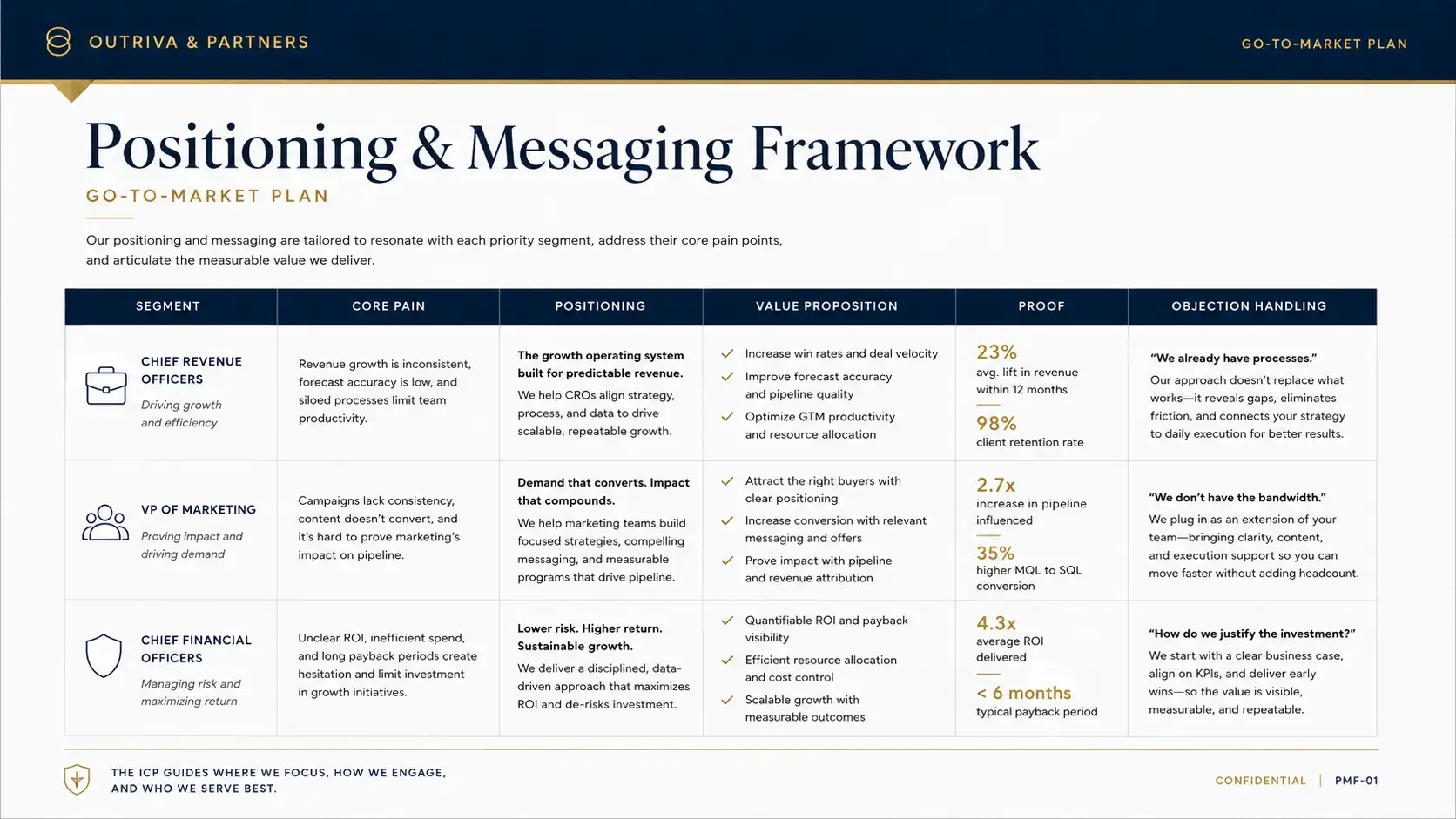
Positioning is the place your product holds in a buyer's mind next to the alternatives. We define that first, then write the messaging framework around it. The framework holds your value proposition, the proof behind each claim, and your competitive differentiation in words a buyer recognises. You get a version for each segment, not one message for everyone.

Channel and sales motion selection

We pick the routes to market that match your deal size and your buyer's process. Options include outbound (you contact buyers first), inbound (they find you), and product-led growth, where free use of the product does the selling. Partner-led selling, demand generation and account-based marketing (ABM) are the other routes we assess. We choose two or three and say why, rather than trying everything.

Offer and pricing design

Pricing and packaging decide how easy your product is to buy. We look at what you sell as a unit, which tiers you offer, and where the first paid step sits. We compare your prices with the alternatives your buyers already consider. Then we check the model against your customer acquisition cost (CAC), so it holds once sales and marketing costs are in.

Pipeline model and targets

You get a simple model that connects activity to revenue. It works backwards from your revenue goal through win rate, average deal value and sales cycle length, and shows how many conversations each stage needs. The model also sets the standard for lead qualification, so your team agrees what counts as a real opportunity.

90-day execution roadmap

The plan ends with a dated roadmap for the first 90 days. It names the target accounts, the channels in play, the sales enablement material, and the owner of each step. Weeks one to four cover setup and list building. Weeks five to twelve cover live outreach and adjustment.


Send us your current plan. We will tell you what we would change.

Send your plan →

The process

How we work, including market entry strategy consulting

Most projects run four to six weeks from start to handover.

Week one

Discovery

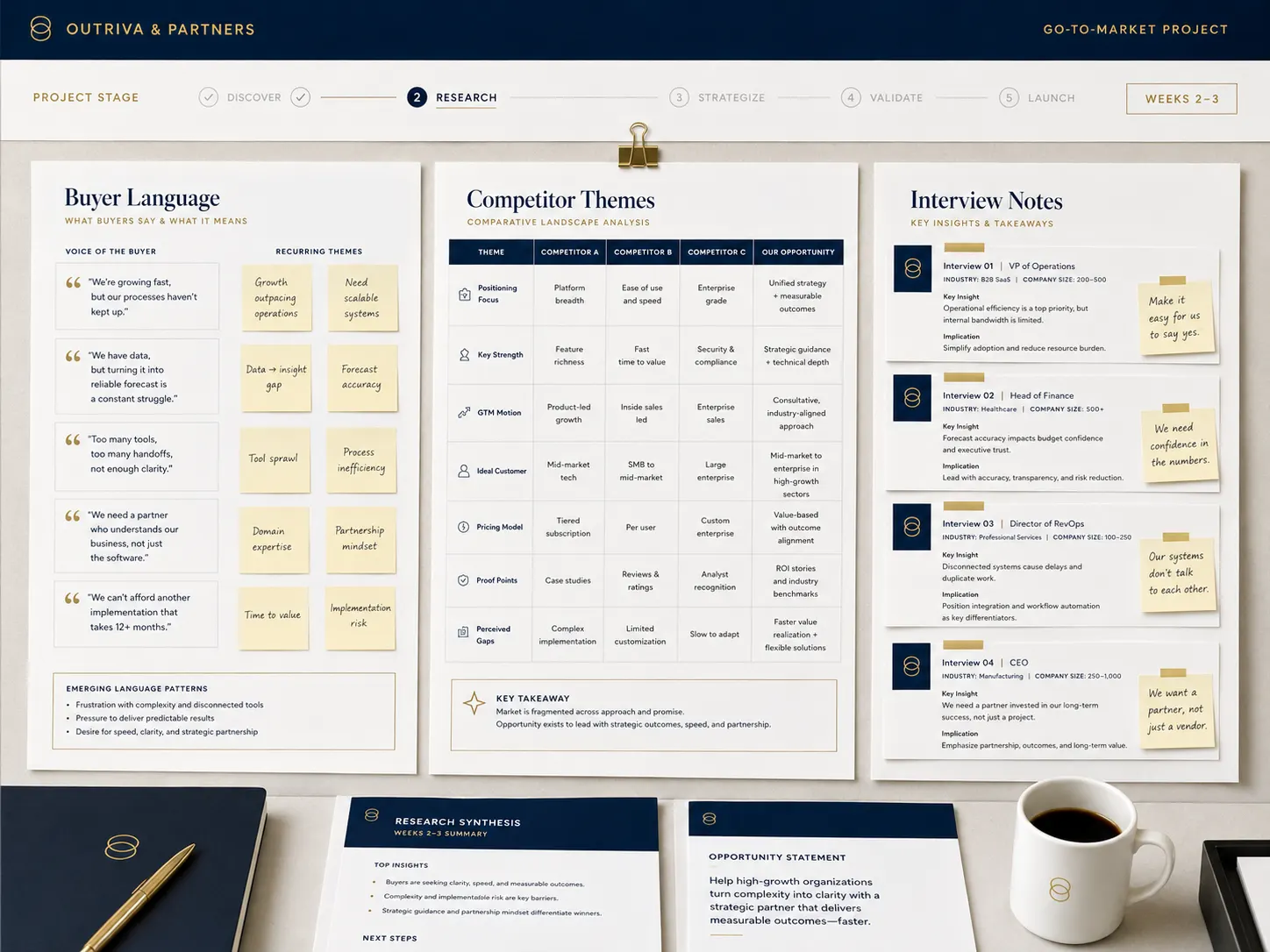
We interview your founders, your sales team and, where possible, recent buyers. You give us access to your call recordings, your sales system and your current numbers. Two hours of your time in this week is usually enough.

Weeks two and three

Research and validation

We study competitors, demand and buyer language in your target countries. For a new region, market entry strategy consulting also covers local buying habits, any regulation that affects your category, and the localisation your messaging needs. Market entry rarely fails on product. It fails on assumptions carried across a border.

Week four

Build

We write the plan, the messaging and the model, then review the draft with you. You give us one round of feedback within a week.

Week five onwards

Handover and execution

We walk your team through the plan, then start the outreach. You decide how much we run and how much stays in-house.

Discovery Research and validation Build Handover and execution WEEK 1 WEEK 2 WEEK 4 WEEK 5 ONWARDS

Shape of a single market. Each extra country adds one to two weeks of research.

Deliverables

What you receive

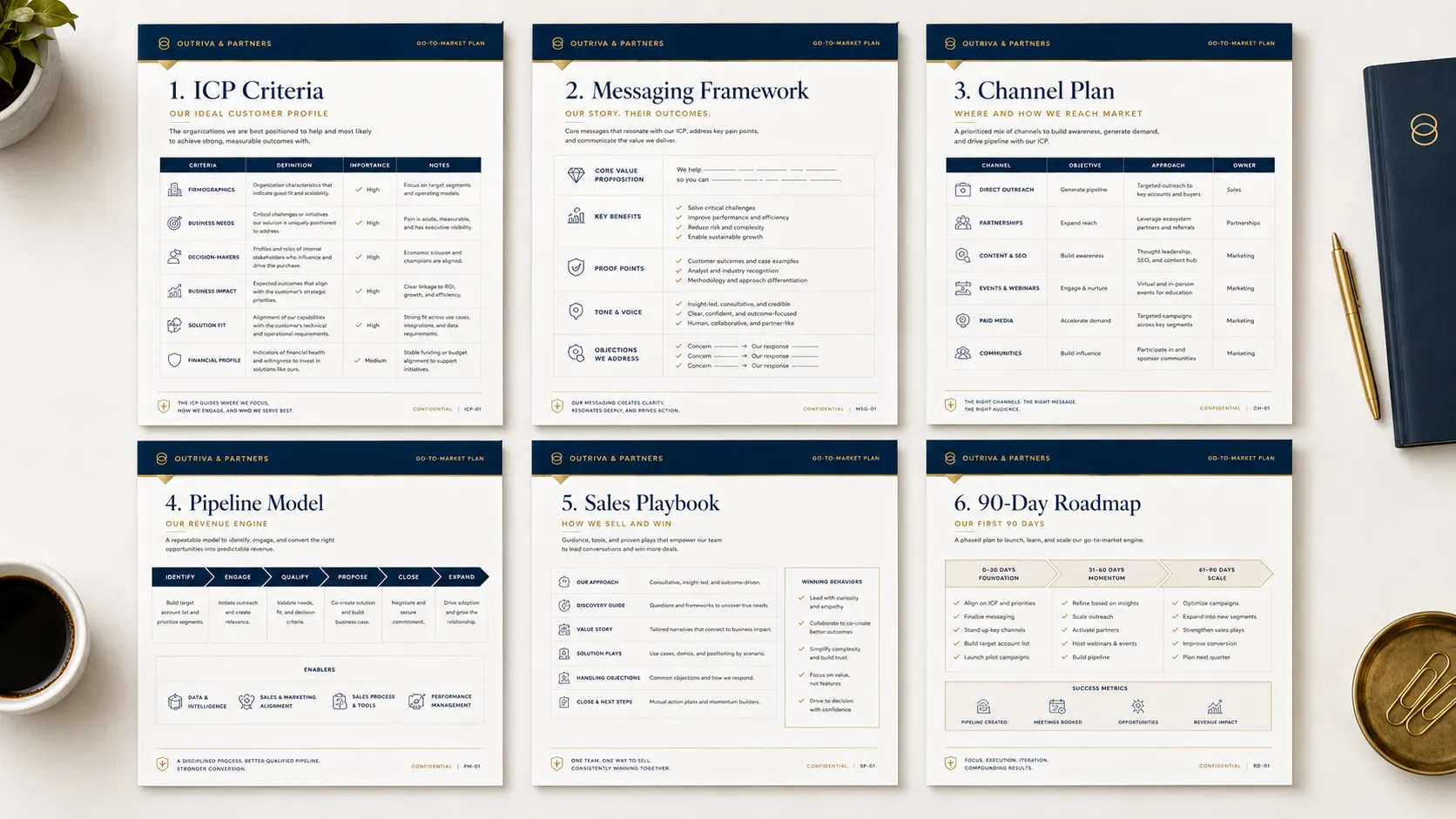
Every project ends with six documents that you own and can edit.

  • An ICP document with target account criteria and the buyer personas behind them.
  • A messaging framework covering positioning, value proposition and objection handling for each segment.
  • A channel plan showing where to sell and in what order.
  • A pipeline model in a spreadsheet you can change.
  • A sales playbook with call structure, discovery questions and email sequences.
  • A 90-day roadmap with owners and dates.

Everything arrives in working files, not slides you cannot edit. Your team keeps all of it after the project ends.

Examples of past deliverables are available on request, so get in touch and we will send work relevant to your market.

The Assured Outreach Model

Why work with OUTRIVA & PARTNERS as your B2B go-to-market strategy agency

Most consultancies hand over a deck and leave. We stay and run the outreach.

That is the Assured Outreach Model. We agree the key performance indicators (KPIs) up front, usually meetings booked or qualified opportunities created.

OUTRIVA & PARTNERS Assured Outreach Model  /  Standard Terms

If the campaign has not met them by the end of the agreed period, outreach continues at no extra charge until it does.

  • iThis changes how the plan gets written.
  • iiA B2B go-to-market strategy agency that has to execute its own advice writes more carefully, because a weak ICP or the wrong channel becomes our problem too.
  • iiiYou get the plan and the team that runs it.
Book a call →

Common questions

Frequently asked questions

What is the difference between a go-to-market strategy and a marketing strategy?

A go-to-market strategy covers the whole route to revenue, including sales, pricing, channels and target accounts. A marketing strategy is one part of it. Marketing creates attention and demand. The wider plan decides who you want, what you charge and how the deal closes.

How long does it take?

Four to six weeks from kick-off to handover in a single market. Add one to two weeks for each extra country, because research and language work take longer. Execution starts straight after handover, so you are not waiting for a perfect document.

Does this suit early-stage companies?

Yes, if you have sold something already. We need real buyer conversations to work from. If nobody has bought yet, talk to potential buyers for a few weeks first, then come back to us. Otherwise the plan rests on opinion.

What happens after the strategy is delivered?

Usually we run the outreach. Under the Assured Outreach Model we move from plan to live campaigns, and we change the plan as buyers respond. You can also take the documents in-house and run them with your own team. You decide before the project starts.

Do you cover our region?

We work across Europe, APAC and the Middle East. Country-level research sits inside every project, so a plan for Germany looks different from one for Singapore or the UAE. Tell us where you are selling and we will say honestly if we fit.

The next step

Send us a short note about your product and the markets you want to reach.

We will come back with our view of the opportunity, the questions we would need answered, and a clear scope for the work.

By browsing this website, you agree to our privacy policy.
I Agree